DuPont Schedule
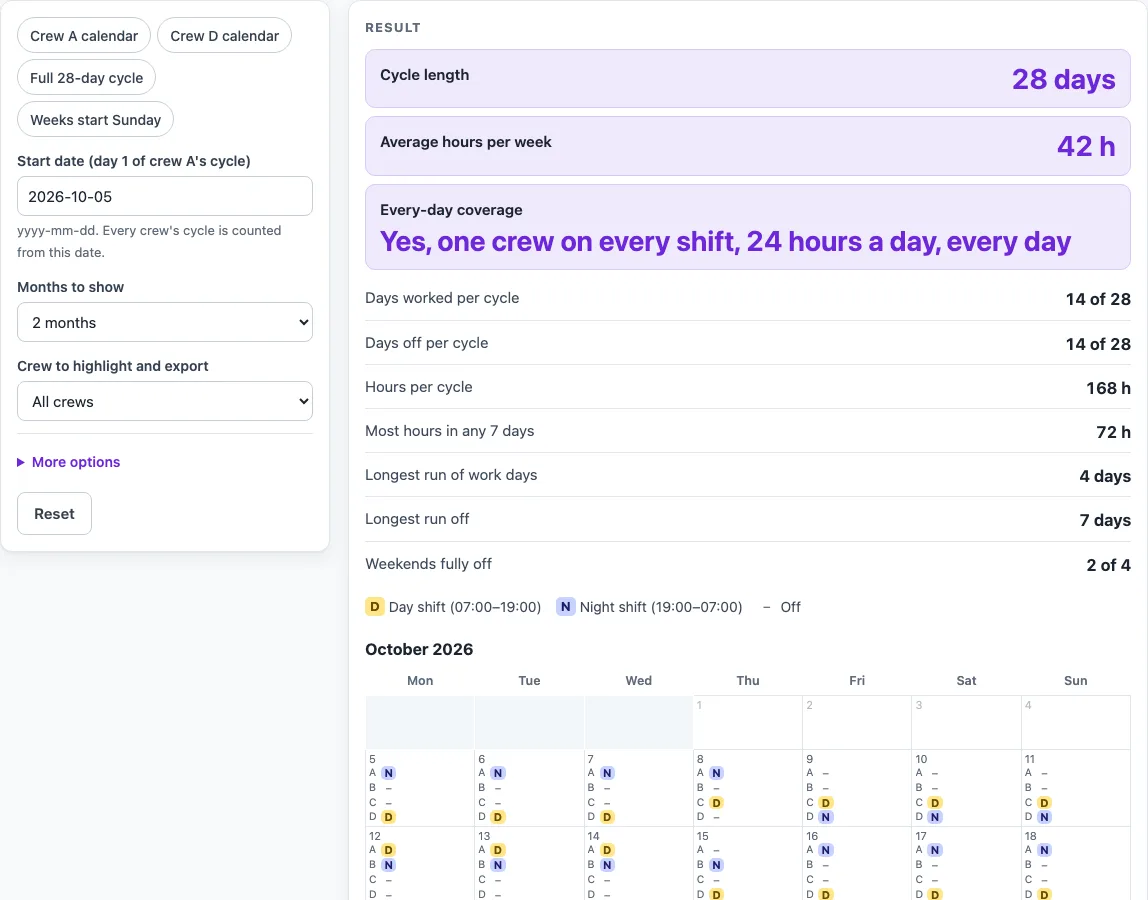
Pick a start date to see the DuPont four-crew, 28-day pattern of 12-hour night and day shifts on a calendar.
Recent
Your last 10 settings, saved only in this browser. Nothing is uploaded.
How to use the DuPont Schedule
- Enter a start date in the yyyy-mm-dd format. The page opens with 2026-10-05, which is a Monday.
- Choose the number of months to show from the months selector, such as 2 or 3.
- Choose a crew: All crews, or Crew A, B, C or D.
- Check the day and night shift times. The defaults are 07:00 to 19:00 for days and 19:00 to 07:00 for nights, written in 24-hour clock time. Change them only if your shifts start at different times.
- Read the results: cycle length, days worked and off per cycle, hours per cycle, average hours per week, the most hours in any 7 consecutive days, longest runs of work and rest, weekends fully off, and whether every day is covered.
- Click Download .ics to get a calendar file for the chosen crew. If All crews is selected, there is one button for each crew.
To keep or share the setup, or to print it, see the questions below.
Presets load the crew A calendar, the crew D calendar, the full 28-day cycle and a calendar with weeks starting on Sunday. Reset returns to the starting example. The cycle table under the calendar lists all 28 days of the pattern for the four crews.
The DuPont rotation runs on a 28-day cycle. Crew A follows this code, where N is a night shift, D is a day shift, and O is off: N N N N O O O D D D O N N N O O O D D D D O O O O O O O. Crews B, C and D use the same code, starting 7, 14 and 21 days later. Because of this offset, exactly one day crew and one night crew are on duty every day, so days and nights are covered around the clock.
Each crew works 14 shifts of 12 hours, which is 168 hours in 28 days. Spread evenly, that is 168 × 7 ÷ 28 = 42 hours per week. The longest run of work days is 4 and the longest run off is 7 for every crew.
The 28-day cycle does not line up with calendar weeks, so weekly hours vary. With a Monday start, crew A’s calendar weeks contain 48, 72, 48 and 0 hours in turn. The most hours in any 7 consecutive days is 72, and the fewest is 0.
What does the cycle table show?
Under the calendar, the cycle table lists every day of one full cycle, with the date of its first occurrence from your start date and the code each crew works that day. D is a day shift, N a night shift and a dash is a day off. If you choose one crew in the crew selector, that column is outlined.
How do I use the calendar file?
Download .ics builds a calendar file in your browser with one timed event for each work day of the chosen crew, from the start date to the end of the last month shown. Open the file in your calendar program to import the events. The times are plain clock times with no time zone, so a calendar app shows them in your own zone. Nothing is uploaded.
Why is the DuPont schedule called a four-crew pattern?
Because it needs four crews. Each crew is crew A’s 28-day code shifted by 7 days, so at any time one crew is on days, one is on nights, and two are off. That is why the page offers four crews only.
Worked examples
| Input | Result |
|---|---|
| Start 2026-10-05, 2 month(s), All crews | 28 days cycle, 42 h per week on average, 14 of 28 days worked |
| Start 2026-10-05, 3 month(s), Crew A | 28 days cycle, 42 h per week on average, 14 of 28 days worked |
| Start 2027-03-01, 2 month(s), Crew D | 28 days cycle, 42 h per week on average, 14 of 28 days worked |
Calculated by the tool above; open it with the same values to see each step.
Frequently asked questions
What happens if I enter a date that does not exist?
The page shows an error message. The start date must be a real calendar date written as yyyy-mm-dd, so a date such as 2026-02-30 is rejected.
Why does the page start on 2026-10-05?
That is a fixed example start date, and it is a Monday. It is not today’s date. Enter any real date to see the pattern from that day.
Can I use a two-crew version instead?
No. A 28-day cycle needs four crews to cover days and nights 24 hours a day with 12-hour shifts, so this page has no two-crew version.
Why do I get a warning about my shift times?
Each shift is counted as 12 hours in the hours figures. The shift times are used only for the calendar file, so a warning appears if the times you type last a different number of hours.
Does the tool check whether a pattern is legal?
No. The page only does arithmetic on the pattern. It does not state any working-time, rest or pay rules, so check any pattern against your own agreement and local rules.
When does crew B start its first night?
With a 2026-10-05 start, crew B’s first night is on October 12, crew C’s is on October 19, and crew D’s is on October 26. Crew A’s calendar file for 2026-10-05 to 2026-11-30 contains 29 events.
Is this tool free, and is anything I type uploaded?
Yes, it is free and needs no account or sign-up. Everything is calculated in your browser, and nothing you type is uploaded.
Can I print it or share it?
Yes. Print / save as PDF prints the page as you see it; choose Save as PDF in the print dialog to keep a file. Copy link copies a page address that stores your inputs, so the same schedule can be reopened later or sent to someone else.
Related tools
- Pitman Schedule: the Pitman 2-2-3 pattern for four crews.
- 9/80 Work Schedule: the 9/80 compressed schedule with every other Friday off.
- 2-3-2 Work Schedule: the 2-3-2 pattern, the same cycle as 2-2-3.
- Panama Schedule: the Panama 2-2-3 pattern with crews swapping days and nights.
- 2-2-3 Schedule: the 2-2-3 pattern, also written as 3-2-2-3.
- 4 On 4 Off Schedule: four days on and four days off for two or four crews.
- 4 On 3 Off Schedule: work patterns such as 4 on 3 off and 3 on 4 off.
- Continental Shift Pattern: the four-crew continental pattern.
- Firefighter Shift Schedule: 24/48, 24/72 and 48/96 platoon calendars.