4 On 3 Off Schedule
Choose how many days you work and how many you are off, and see the pattern on a calendar with your hours per week.
Recent
Your last 10 settings, saved only in this browser. Nothing is uploaded.
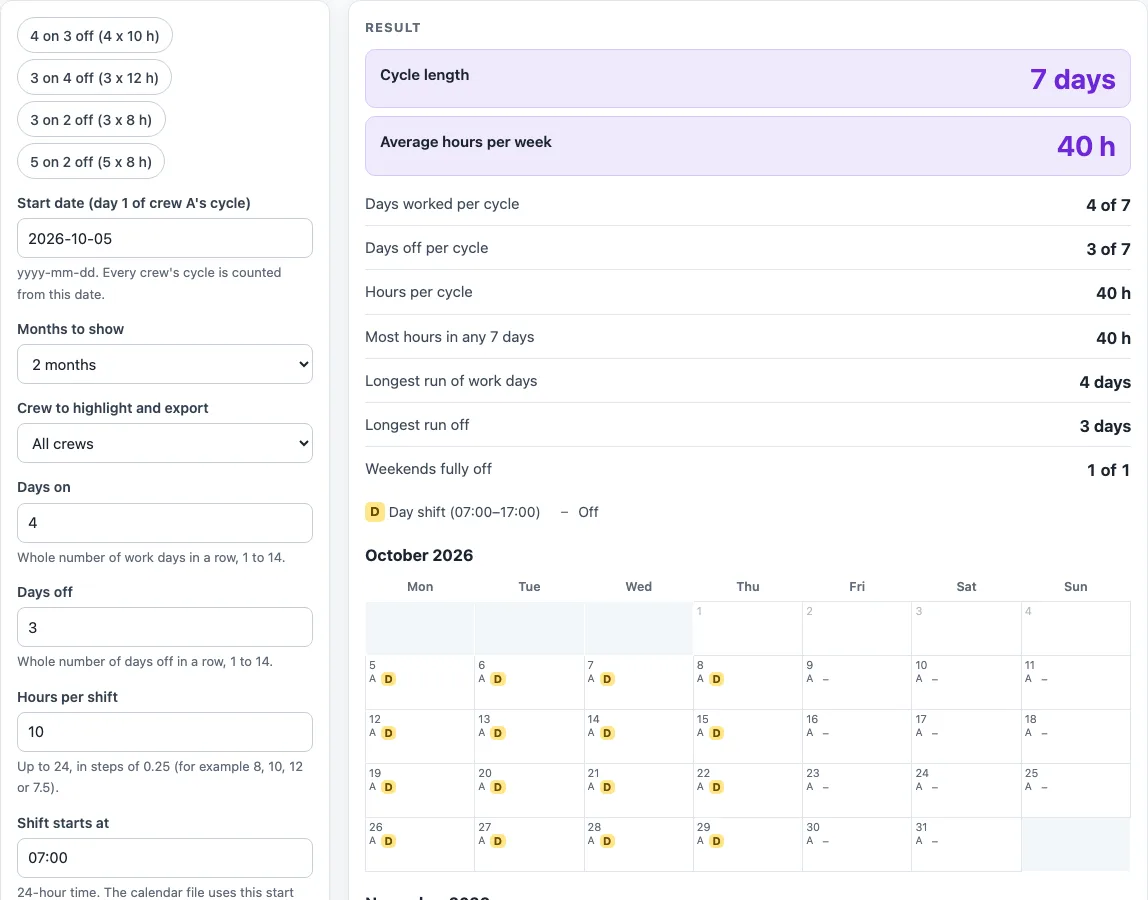
How to use the 4 On 3 Off Schedule Tool
- Enter days on. The default is 4. Allowed values are 1 to 14.
- Enter days off. The default is 3. Allowed values are 1 to 14.
- Enter hours per shift. The default is 10. You can go up to 24 hours, in steps of 0.25 (for example 7.5 or 12.25).
- Set the start date. The default is 2026-10-05. The first day of the cycle falls on this date.
- Set the shift start time in hh:mm format. The default is 07:00.
- Read the results: cycle length, hours per cycle, average hours per week and weekends worked in 8 weeks.
- Choose the calendar options: 1 to 12 months, with weeks starting on Monday or Sunday.
- Download the .ics file to add the shifts to your calendar app. The file is made in your browser.
For a quick start, use one of the presets: 4 on 3 off with 10-hour shifts, 3 on 4 off with 12-hour shifts, 3 on 2 off with 8-hour shifts, or 5 on 2 off with 8-hour shifts. Each preset fills in all three numbers for you, and you can still edit them afterwards.
Presets load 4 on 3 off at 10 hours, 3 on 4 off at 12 hours, 3 on 2 off at 8 hours and 5 on 2 off. After a preset loads you can still change any number. The hours per shift field accepts steps of 0.25, so 7.5 and 10.25 both work.
How is the average hours per week worked out?
Multiply days on by hours per shift, then by 7, and divide by the cycle length (days on + days off). For 4 on 3 off at 10 hours, that is 4 × 10 × 7 ÷ 7 = 40 hours per week. For 3 on 2 off at 8 hours, it is 3 × 8 × 7 ÷ 5 = 33.6 hours per week.
The cycle itself is simple. The crew works the day-shift code D for the days on, is off for the days off, and then repeats. The longest run on equals the days on, and the longest run off equals the days off, because each cycle has only one block of each.
Why does a 7-day cycle keep the same weekdays?
When days on + days off equals 7, the same weekdays are worked every week. Patterns such as 4 on 3 off, 3 on 4 off and 5 on 2 off all have 7-day cycles, so a crew that starts on Monday works Monday to Thursday every week.
Any other cycle length drifts through the week. For example, 3 on 2 off has a 5-day cycle, so the work days move one weekday later each week. The pattern returns to the same weekdays only after 35 days (5 weeks).
How are weekends worked counted over 8 weeks?
The tool looks at 8 calendar weeks, Monday to Sunday. The first week is the one containing the start date, and the cycle is also run backwards for any days before the start date. A weekend counts as worked when Saturday or Sunday is a work day.
This is why the start day matters. With 4 on 3 off starting on Monday 2026-10-05, the work days are Monday to Thursday, so 0 of 8 weeks include a weekend. Starting the same pattern on Saturday 2026-10-10 works the weekend in all 8 weeks. Starting 3 on 2 off on Monday 2026-10-05 works a weekend in 7 of the 8 weeks.
Does the schedule show round-the-clock coverage?
No. The tool models one crew only. It reports the hours and days that crew works, not whether a site is staffed at all times.
Shift times follow from the start time and the shift length. A 10-hour shift starting at 07:00 runs to 17:00. A 24-hour shift ends at the same time on the next day. The tool does only schedule arithmetic, so it says nothing about what any agreement or rule requires for hours, rest or overtime.
Worked examples
| Input | Result |
|---|---|
| 4 on 3 off, 10-hour shifts, start 2026-10-05 | 40 h per week on average, weekends worked in 8 weeks: 0 |
| 3 on 4 off, 12-hour shifts, start 2026-10-08 | 36 h per week on average, weekends worked in 8 weeks: 8 |
| 3 on 2 off, 8-hour shifts, start 2026-10-05 | 33.6 h per week on average, weekends worked in 8 weeks: 7 |
| 5 on 2 off, 8-hour shifts, start 2026-10-07 | 40 h per week on average, weekends worked in 8 weeks: 8 |
Calculated by the tool above; open it with the same values to see each step.
Frequently asked questions
What happens if I enter a value that is not allowed?
The tool shows an error message and does not show a calendar. This happens if days on or off are outside 1 to 14, hours are not in steps of 0.25, the start time is not in hh:mm format, or the start date is not a real date.
How many calendar events does the default schedule make?
For the default settings, 2 months from 2026-10-05 produce 33 events.
Is this tool free, and is anything I type uploaded?
Yes, it is free and needs no account or sign-up. Everything is calculated in your browser, and nothing you type is uploaded.
Can I print it or share it?
Yes. Print / save as PDF prints the page as you see it; choose Save as PDF in the print dialog to keep a file. Copy link copies a page address that stores your inputs, so the same schedule can be reopened later or sent to someone else.
Can I use 12-hour shifts?
Yes. Set the hours per shift to 12 and the days on and off you need, for example 3 on 4 off. The average hours per week is days on times hours times 7 divided by the cycle length.
Related tools
- Pitman Schedule: the Pitman 2-2-3 pattern for four crews.
- 9/80 Work Schedule: the 9/80 compressed schedule with every other Friday off.
- 2-3-2 Work Schedule: the 2-3-2 pattern, the same cycle as 2-2-3.
- DuPont Schedule: the 28-day DuPont pattern for four crews.
- Panama Schedule: the Panama 2-2-3 pattern with crews swapping days and nights.
- 2-2-3 Schedule: the 2-2-3 pattern, also written as 3-2-2-3.
- 4 On 4 Off Schedule: four days on and four days off for two or four crews.
- Continental Shift Pattern: the four-crew continental pattern.
- Firefighter Shift Schedule: 24/48, 24/72 and 48/96 platoon calendars.